Welcome to Montana Trout Fishing!

Bringing you up-to-date information for fishing around Bozeman Montana. Feel free to Email me anytime at Norbaracer13@gmail.com!
Showing posts with label Trout. Show all posts

Tuesday, March 9, 2021

High Pressure and Hellish Riverbanks

         If you find that your home waters are exceptionally beautiful and full of wild trout, you may be facing increased fishing pressure over the years as people from all over the world flock your way. There are only so many rivers, and for every new angler that moves to your region, that is one small piece that you'll no longer get to enjoy in solitude, peace, or quiet. 

         Where I live, every year there is open comment on how to better regulate the summer madness on the Madison River for example. Outfitters complain that there are too many boats out during prime-time angling mid summer, and that added pressure hurts their business. As Bozeman grows by five thousand residents a year, thats X amount of hikers, anglers, hunters, all showing up at your favorite accesses. Five, ten, twenty years ago (and rarely today) you could show up to one of many rivers and smile as you're the only vehicle pulling up, the happy river awaiting. Nowadays, if you show up to an easy to access, popular trail head or fishing access, you're almost engulfed in a feeling of dread and disgust. 

          As an angler, always learning, we have our favorite spots, our honey holes, and they too change as we grow. We have our favorite stretches of river that we think about to get through a hectic day at work, or perhaps a favorite time of day at a certain run on a lazy, quiet flowing stream. Sometimes we go days or years between frolicking around the waters waste deep, but it ultimately calls you back, for reasons unknown, often overlooked. We just know that "we need" that moment of tranquility, or we have the itch to hook a trout on a dry fly, so we head out to our favorite stream on a seemingly quiet Sunday morning, just to pull up and have your whole mood turned upside down as the parking lot has turned into a zoo. Whats a fisherman or lady to do? There are a couple options, some better for some than others, depending who you are and what kind of fisherman. 

           Fish the weekdays! If you live in a destination location, you realize that people travel from around the world to experience a day or two, or week enjoying what you have anytime. Vacationers often do not have a set schedule, and are often the ones being guided any day of the week. You can easily avoid where guides take their clients, but I have learned that these are not the ones crowding our rivers. Also its important to point out that most "tourists" do not get out beyond the normal "tourist spots", and they are very easy to avoid. Most locals, hard working folks that know the area and are exploiting for themselves (rightfully so!), have to get out on the weekends. Weekends, beginning in early March have trailheads and river access overflowing with area natives itching to get out to their favorite trail or stream. If you live and work in one of these great places on earth, and you enjoy solitude outdoors, it would be wise to ask your boss to work weekends!

          Get an early start! Most fisherman that want to get the most out of their time on the water like to get out to the river early! Some of the best fishing of the day, certain times of the year, take place between sunup at 10am. Many easy going anglers are going to sleep in, and start fishing much later, continuing to to hit the evening hatches. 

           Avoid the popular areas! Sure, your favorite river or stretch may be the most popular, sought after stretch in one hundred miles, that would be a bummer! However, many of the most popular put ins, bridges, access, and parking lots are so overloaded with pressure, that unless you're the first angler to hit it that day, its just not something to pursue with heavy crowds and pressure.. You may be thinking that the stretches with nobody fishing cant be as good as the ones loaded with boats and waders, but that is FALSE! Most of these rivers and streams have thousands upon thousands of trout per mile, trust me, they are everywhere. You can do some things like simply fish these areas during the off season, or early mornings, and may increase your odds of success and enjoyment. 

           Fish out of season! It seems that July through August is the busiest time for trout fishing in Montana. Guides are booked everyday, every campground is taken, RV's and campers outnumber commuting vehicles. Mid to late summer is also the nicest time of year and experiences some of the best fishing (although I disagree on the latter, read on). This makes that time of year extremely hectic at the popular fishing rivers, lakes, streams, and accesses. The trout are at their all time most picky when it comes to preference feeding and certain flies. So you have highly pressured, extra finicky trout matched up with extremely high angler numbers and sure that can lead to a nice day sometimes, but for me that's a headache. Some of THE BEST trout fishing occurs when the weather is NASTY. That means mid march till early may, and October-November. During these times you have extraordinarily hungry fish loading up their stores for winter matched up with seemingly nonexistent crowds and pressure. As an ex walleye fisherman myself, I always led with the motto "The shittier the weather, the better the fishing" and "fish dont care if they get wet, they're already wet".

           This one is similar to the previous tactic but one of my favorites! Sure, July to August in Montana is spectacularly gorgeous, and it rarely rains those months. However, any other month of the year is bound to throw some weather your way! Raining on a Saturday? Most easy going anglers are going to stay indoors, or maybe take a drive. Put on the rain gear and get out there for some great fishing. Snowing sideways, might as well get out there and experience the beauty of the gloom on a stretch of your favorite river all by yourself, or with a tail wagging friend. Just remember, the cold, the rain, and the wind will keep half the anglers off the water! Its not a bad thing to schedule a day on Depuy's or head up to the park when the weather is 'subpar' for some of the best fishing experiences.

           Walk at least a mile from the rig! There are things an angler can do during the busy hours on a world class river or stream to beat the crowds and pressure. Just add anyone of the above tactics together, and experience even better odds of solitude! If you show up at an access to your favorite river and its full of people, you better plan on hiking out a ways if you want to experience easy going trout and less competition with people and more with the eagles. I always start AT LEAST a mile from the rig, and see what it looks like from there. Now, don't be surprised when there are a few others like you, escaping the hellish outdoor experience of the once a year fly fisherman and his two misbehaved setters ruining your honey hole, or the hollering and yelling of drunken worm drowners at the boat ramp. Typically once you're this far out from the madness, you can really spread out and slow down, enjoying your time there without the pressure or distraction. 

              As more and more people flock away from big cities to smaller, rural western locales, these small rivers and ecosystems will begin to feel the weight. You'll need to walk further and longer to get out there away from people, but this will also open new opportunities for the wanderlusting adventurer. I cant complain or deny my existence here, I am only a ten year resident here in the great state of Montana. These are some tips I learned to beat the crowds and I hope you too can enjoy a moment of peace as things grow and change. Tight lines! -Mike

Saturday, May 26, 2018

Smith River Float 2018


           When my good friend Cody first told me that he drew for the Smith River in early May I declined. After a seemingly longer than usual winter, camping during a cold, wet spring turned me off. It wasn't long after his offer when a news story appeared about a group of Smith floaters who were rather unlucky. They were the third group to float the river this year, and early April trips can be very cold. Waking up to snow on the tent is one thing, but group three woke up to a completely frozen Smith River. Fortunately they were close to a ranch road and were able to get help. That was April 8th. Cody's float was scheduled a full month later but its not uncommon to have snow up into July there. The Smith begins its journey to the Missouri River from the Castle Mountains in South Central Montana. It then winds its way through farm land and cattle country before entering Smith River State Park. Here, the river flows for fifty-nine miles through some of the most beautiful country around. The Smith's highly protected waters are the prize that so many cherish and will travel many miles to float. There are a limited number of permits given each year, via a lottery system, which 6,000 people that hope to draw, only about 1,000 or so will be lucky.  It wasn't long before I changed my mind.  Several warmer than average days came in mid April and I was itching to kick my cabin fever, let alone in one of this country's most beautiful places. I mean, what was I thinking saying no?

Camp Baker morning of the launch

                After waiting for what seemed like an eternity, May 7th was finally here. With my truck loaded full of gear and the raft, I began the two and a half hour drive north to the check-in station at Camp Baker. My plan was to leave Bozeman and show up a night early to reserve an early launch for the group, but by the time I arrived my name was already fifth on the list; apparently, 1 pm the day before isn't early enough! Camp Baker soon filled with nine groups, our group of four being the smallest, all the way up to the bigger groups, with around fifteen people. The scene at camp was a lively one. One hundred people all hanging out in a unique landscape, all there for the same reason. Not one soul had to work for the next five days, and the beer count was already taking a hit. The mood was very chill and relaxing. I was a little worried about tomorrows launch, unsure of what the river would throw at us. Did we bring enough gear? Do we have enough food? Is it going to snow on us? How bad are the whitewater rapids with these high flows?

Ranger discussion at Camp Baker
             After a night of rest it was around seven the next day that Camp Baker came to life. People packing up their tents, prepping for the next days, the clinking of pots and pans and oars and anchors. We all migrated to the ranger station where we had a twenty minute group chat with the USFS ranger. He was great and went over everything we would encounter, such as springs, pictographs, rapids, float gates, etc. I'm glad I took notes because he was saying all kinds of things, rather fast, and nothing is marked on the map except for camps and tributaries.

                                                                                                                                                                                                                                                                                               At around nine o'clock we had to register our campsites with the ranger. 
We didn't have a clue as to which camps were good, besides the little research we'd done, so sort of took the rangers word for it. Our flotilla was small and because we were all ready to go, we ended up being the second group to launch. We carefully loaded all of our provisions for the next four days into our rubber boats, and there we stood before the raging, chocolate milk colored water that we've been itchin' to meet for months. Our boats packed to the max, hundreds of pounds of gear. I actually wondered if mine would sink while going through the first set of whitewater rapids. Once the last bit of gear was strapped tight to the rafts we ran up to the station to tell the ranger we were ready for his inspection.
Last gear check
He dropped his pen, and with a smile on his face, followed my anxious butt down to the ramp. Without even looking over our stuff, he said "You guys all ready for a good time?", we replied with a nervous "Yeaaaaaaah". It was after this that he said "Alright, good to go, have a good time guys!". I was hoping we were set up with the right gear and weren't launching to our deaths. With the water at record flows, I knew this could be a challenge in my raft, which is much smaller than the regular rafts that float these waters. The first bend didn't send us over a waterfall, or push us against a cliff, and we slowly meandered and tapered our way into more narrow terrain. I thought the first stretch would be a lazy one and that maybe we would slowly transition into a more rugged environment. To my surprised it wasn't but after the first couple miles when the environment began to change into that steep canyon country in so many photos.
Our first mile on a new river

                  It was this first day on the river that we spotted a sow black bear and cub. The mom had a watchful eye over the little one, who was grazing on riverside vegetation, talk about a shore-lunch. They didn't fear us, and watched as we quietly floated by. The day was warm and sunny, the river calm and peaceful. There was a calmness in the air, the smell of pine, the sound of the occasional duck taking off, or a gaggle of geese passing by overhead. There was a sense of wonder as to what would be around the next turn in the river. The current was pushing us at about four or five knots, it was tough to sit back and take it all in.
Sow black bear and cub
It didn't take long for our life jackets to come off. The Smith gave us a pleasant, welcoming feeling that first day. Stress slowly turned into relaxation and contentment. Both rafts, although heavy, were navigating impeccably through the giant boulders, shelves, and limestone walls. There are few things more calming than drifting effortlessly through a wilderness such as this. Oh how I wish it would never end.

                  We made it to our first camp in a hurry that day. We left plenty of room for a longer than expected float, or in case something happened, we wanted to have tents up before dark. It only took us three hours to float the days seventeen miles.
Boat camp Syringa
Camp Syringa is the name of our camp for the evening. It sits in a quiet part of the canyon, where the water flows slower than most other places. We tied our boats to the provided 4x4s sticking into the grass covered bank. The fire ring is located about twenty yards upstream from the boats and the latrine was a short hike up into the hills behind camp. We set up our tents and began cooking dinner. We would be having elk fajitas. After a full belly we tried to stay awake into dark, but we were beat. It wasn't long before camp was quiet other than the sounds of rushing water and the occasional goose.

               I awoke on Wednesday morning around six o'clock. I made a cup of joe and took a hike with my fishing rod. The rest of the group was sleeping in. I figured it would be a good time to wander around and explore the area. I fished for an hour with absolutely no luck. The water didn't look all that bad really. At times the visibility was around eight inches. Once awake, everyone was feeling pretty energized and we were eager to get on the water. After a hearty breakfast of scrambled eggs and biscuits 'n gravy, we consolidated a couple piles of firewood into the rafts, packed our gear, and headed downstream.

           Our first stop on this day was at Tenderfeet Creek. Here we were hoping to find some healthy brown trout in clearer water. We pulled the boats into a small, clear pool of spring fed water. I was less interested in fishing and excited to keep moving down the river. After throwing our lines around for a few minutes and see what we could see, we decided to cut loose. It was near noon and the sun beat down.
         
Pictograph handprints
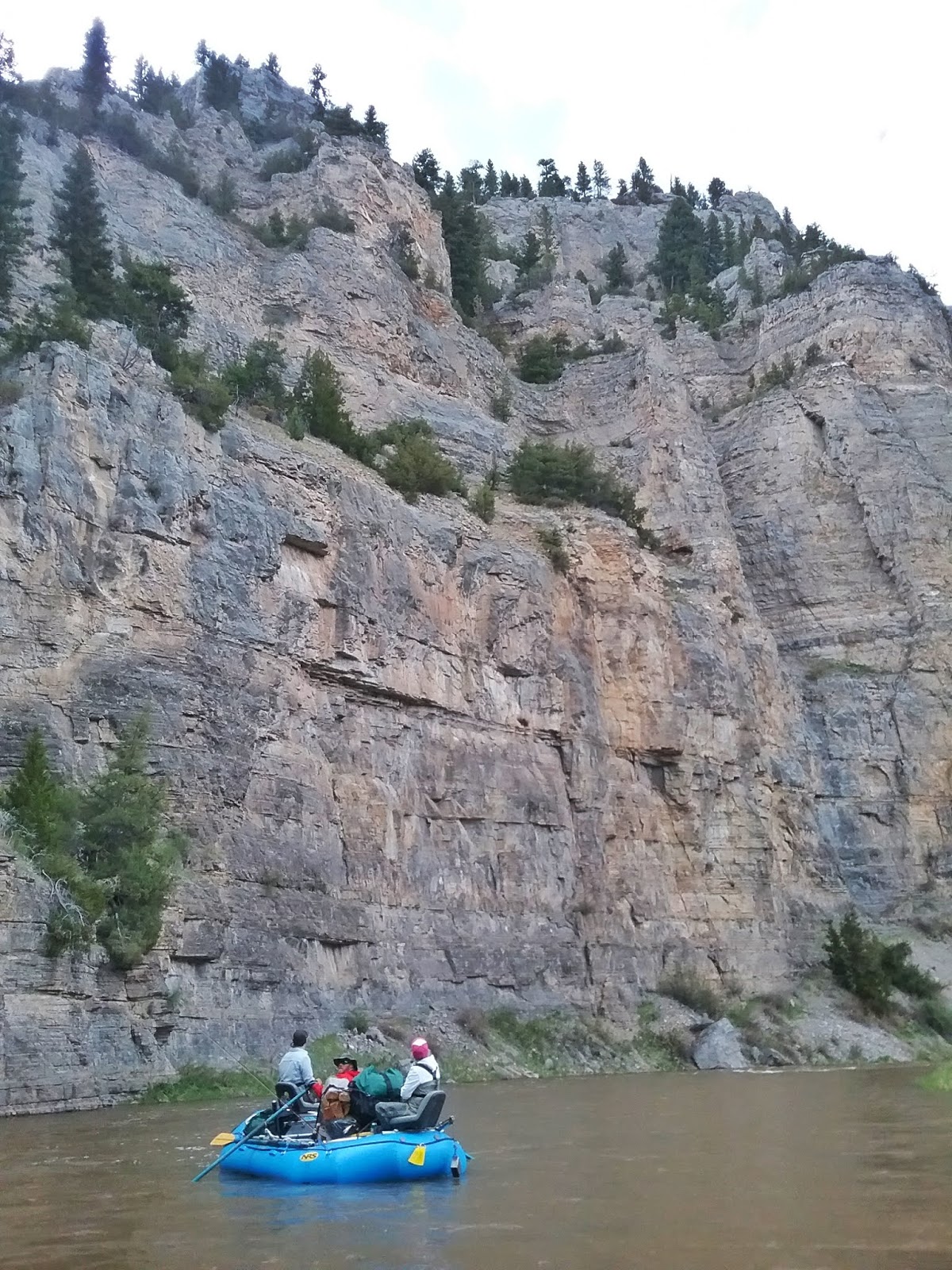
             We twisted and turned around spires taller than any building in the whole state of Montana. The turns, so frequent, that by the time you maneuvered the boat to avoid the turbulence of one turn, you'd have to turn 180 degrees to set yourself up for the next one. I've never drifted down a river so wide that snakes as tightly as the Smith. A few more miles downriver and we witnessed another black bear. This time we watched as it slid down into the river, swam across, then stood up on both legs before turning and running into the wild lands. I tried to swing the boat around for another pic but he was a healthy bear and quickly disappeared like good bears do. The river here was swift and powerful. We had our first pictograph coming up, where exactly we did not know. Keeping the boat on a good line and away from rocks was taking most of my focus. Lucky I was to see this pictograph, as it was about fifteen feet off the water, in the middle of a fast riffle. There were five red hand prints in a horizontal line, and a quick glimpse was all I could get along with a quick photo. At the time, it was a dismal feeling, floating past them at five knots, but we would soon see many more.


        In the middle of a remote stretch of the canyon there sits an oasis to floaters. The Heaven on Earth Ranch is kind of an odd place. You almost have to see it for yourself. We had read about it beforehand and thought we may stop for a drink, or round of golf. Yes, there is a beautifully kept nine hole golf course out in the middle of the Smith River Canyon. They are happy to serve rafters free hard drinks but will take donations. You can also stay at one of their many cabins and enjoy a hot shower or soak in the hot tub. "Shall we stop?", Carly hollered. Dark violet and ominous, the clouds besieging us were moving in fast. There was friction in the air. "Can we keep moving?" I yelled back. A nod was given. I think we all had the same feeling.
spring number two, before the storm
              It wasn't long after the ranch that we stopped to fill our water bottles at a quiet little spring. By now, the sun was gone completely and the sky was ever darkening. An enormous bolt of lightning hit the canyon rim directly above us, thunder instantly rumbled around us. In a moment, our day went from bright and fun to wet and possibly dangerous. While we covered the firewood with tarps we discussed our plans. The rain began to fall hard. "The ranger didn't mention what to do during a lightning storm did he?" I yelled through the sound of rain pelting the water, but I already knew the answer. We couldn't risk losing precious hours holed up under a shelter waiting for it to pass, this thunderstorm could potentially last all day. We tucked our graphite fly rods down low and slowly left our little cove of cover. With our rafts turned and our backs downriver, against the rain we paddled on Water  would eventually finding its way into every little dry space on me. Lightning clapping all around us. I sure felt vulnerable during that hour on the Smith. Natures power can make you feel small at times. I felt some protection from the canyon and hugged the walls until we reached our next camp.

The rain eventually subsided and we made it to our 3rd camp, Camp Crowsfoot. It seemed as we realized there weren't any trees here to hang a tarp for shelter, the rain had stopped.
Evening view from Camp Crows Foot
We were overjoyed when the sun came out, just in time to set up our camp for the evening. A few more hours of daylight were yet to come, so we hiked a short ways to look at some pictographs that Riley had found. I must say, we had a much better look at these than the previous ones. There were probably twenty that we found.
several pictographs from Camp Crows Foot 
The cliff face that held these had eroded heavily over the years, putting a few pictographs on large slabs on the ground. I wondered how many pictopraphs have fallen off over the years; it would appear with some imagination, that the whole limestone wall was at one time covered in paintings. We saw paintings of a buffalo hoof, a fox, hand prints of adults and children, finger prints, finger swipes, symbols and many more we couldn't identify. I myself am a huge fan of ancient peoples, and this site was worth the trip alone.

The canyon walls grow taller 
             After a much needed refueling of spaghetti dinner, we tried sitting around the campfire to enjoy the natural stadium that mother nature had created around us. I found myself pretty tuckered out after each day. You'd think floating down a river would be easy, but the constant chores of moving camp everyday took a lot out of us. We watched as lightning from another thunderstorm rolled closer and closer to us. The rumbling storm slowly moving our way. It was then, as pellets of rain splashed down around us, we ran to our tents. The wind picked up and lightning was striking nearer. I would experience a rather miserable evening that night. The tent had some weatherproofing issues, and eventually succumbed to the constant saturation of wind and rain. All four corners of my shelter had little rivers, all trying to gather in the middle where I lay inside my sleeping bag. It was difficult to sleep, I was worried about waking up covered in water. The temperature would drop into the thirties at night and I did not want to get wet. Around midnight, fatigue finally knocked me out and to my relief, I woke up halfway dry. I wasn't sure if my tent could handle another night of rains. The next morning we woke up to dry weather, the rain had quit sometime early that morning. We splayed out tents, tarps, and our gear to dry that morning. The suns rays were warm and welcome. We found ourselves getting on the water each day between ten and eleven AM.. Averaging around fifteen miles a day and each day we floated for around three hours, with intermittent stops here and there.

             The canyon walls were at their tallest this day, and within them, there was a 'pictograph cave' that we were on the look-out for. It was river mile thirty-eight we discovered it, high above the river. A small trail came into view around a slow bend. The shore was so steep here that instead of landing the rafts, we had to tie them to trees and let them float. We strapped both rigs together to make a large barge that we used to change into more fitting clothing.

Riley sits on the shore in front of pictograph cave
            After lacing up some hiking shoes and finding the bear spray, we had a quick snack. We followed the trail to the cave, which we could clearly see from the rafts. Little did we know that this would be more of a challenge than we anticipated. We knew it was a tad dangerous and difficult to reach, but we figured that was a warning for the 'average folks' out there. Riley and I climbed up to the top of the trail. There were about twenty different foot trails forking all different ways. I made several attempts to locate the right path, and each way took me to precarious ledges and drop offs. We scrambled down and tried an alternate route. Riley found me and we explored this ridge to the fullest. It was one heck of a hike be we ended up walking about one hundred feet under the cave without even seeing it, just to climb above and get an amazing view of the Smith.  We still had a half day of boating to do and decided we could look no more for this darn cave. With low energy, we climbed several hundred feet in elevation looking for it. There is a sort of illusion that plays out when you're there looking for it. The cave is a lot larger than it looks from the bottom and it throws off your judgement. The ground is pretty sketchy and getting hurt out here, thirty miles from the nearest road, is not a good idea. Defeated, we played it safe and decided to head back down to the river.

Our boats at Upper Ridgetop
            After the cave ordeal, we had about five river miles to go. This would put us in camp between four and five o'clock that afternoon. Our destination was Camp Upper Ridgetop, which sat nestled privately in between two other boat camps along a tight, steep turn in the canyon. The boat landing was directly above a left hand turn that quickly turned into a small whitewater rapid. The sound of the water, the view of a steep canyon wall across the river, and the fact that everything was wet, gave Camp Upper Ridgetop, a rain forest/Pacific Northwest feel. The best part of this camp was that it was surrounded by willows and large Douglas-fers, so it was quite cozy.
A short trail from our boats led to our sheltered camping area. The fire pit sits in the middle of a triangle of three towering conifers trees, and each tent-site is isolated, a few yards from where we would all gather for dinner. It managed to stop raining for the few hours, we set up camp and cooked our dinner. We feasted on elk chili and other snacks on this night. The gang preferred to drink coffee in the evening over beer, I guess we are getting old. Speaking of old; it was the day before Cody's thirtieth birthday! What better way to spend a milestone like that than floating down one of the countries unique rivers, in Montana?

Fun around the campfire, Upper Ridgetop
             After a full belly, we explored our little nook of land. We were completely blocked in by an impassable rock wall to our backs, and across the river, there was narrow corridor of public land, also blocked in from the back. We had "camp deer" in our camp on this day. There were six or seven little mule deer does that had no problem with us being there. With few flat, green areas in this rugged country, this was probably where they spent a lot of time. The scenery here was spectacular. At one point, as it began to get dark, I played a game of flashlight tag with one of our neighbors at the camp upriver from us. They were shed hunting and had climbed way up this large rock outcrop. He would shine his light a number of times and I would repeat it. It was enjoyable, noting they were probably a good half mile away and a few hundred feet up the canyon. This was the only night that we could see and hear our neighbors, not to mention our latrine was about twenty feet from the group below latrine. Besides the close proximity toilets, this was our favorite camp. Its amazing how every mile of river will show you something new, and each camp has its own personality and charm. There are better camps than others, so if you plan on doing a Smith float, research some good campsites, write em down and bring them with you. It helps to arrive the morning before the day you float, to reserve the good sites.

         The rain that night once again determined when we would get into our tents and go to bed. This time, I strategically placed my tent under a large pine tree to avoid as much moisture as possible from the monsoon like rains. I tried to position the tent onto a hump, so water wouldn't pool inside, and I added an additional rain tarp over the original for added coverage. Despite my best efforts, the rains were just too strong and consistent. I was tired during the night that I didn't let it bother me as much, and woke up inside a half soaked sleeping bag. I couldn't believe I still managed to get wet, along with most of my stuff in the tent, that wasn't in a dry bag. It was difficult to get up and pack but there wasn't much else to do. Annoyed that we woke up to a very cold and rainy morning, we brewed some coffee, water proofed our bodies and got to work taking down camp.
Staying dry during the rain
There would be no stopping the rain from this point on for the rest of the trip. We would have no way to dry all of the gear, so if we were planning on another night, we would have been soggy. We left Camp Upper Ridgetop at eleven o'clock that morning.

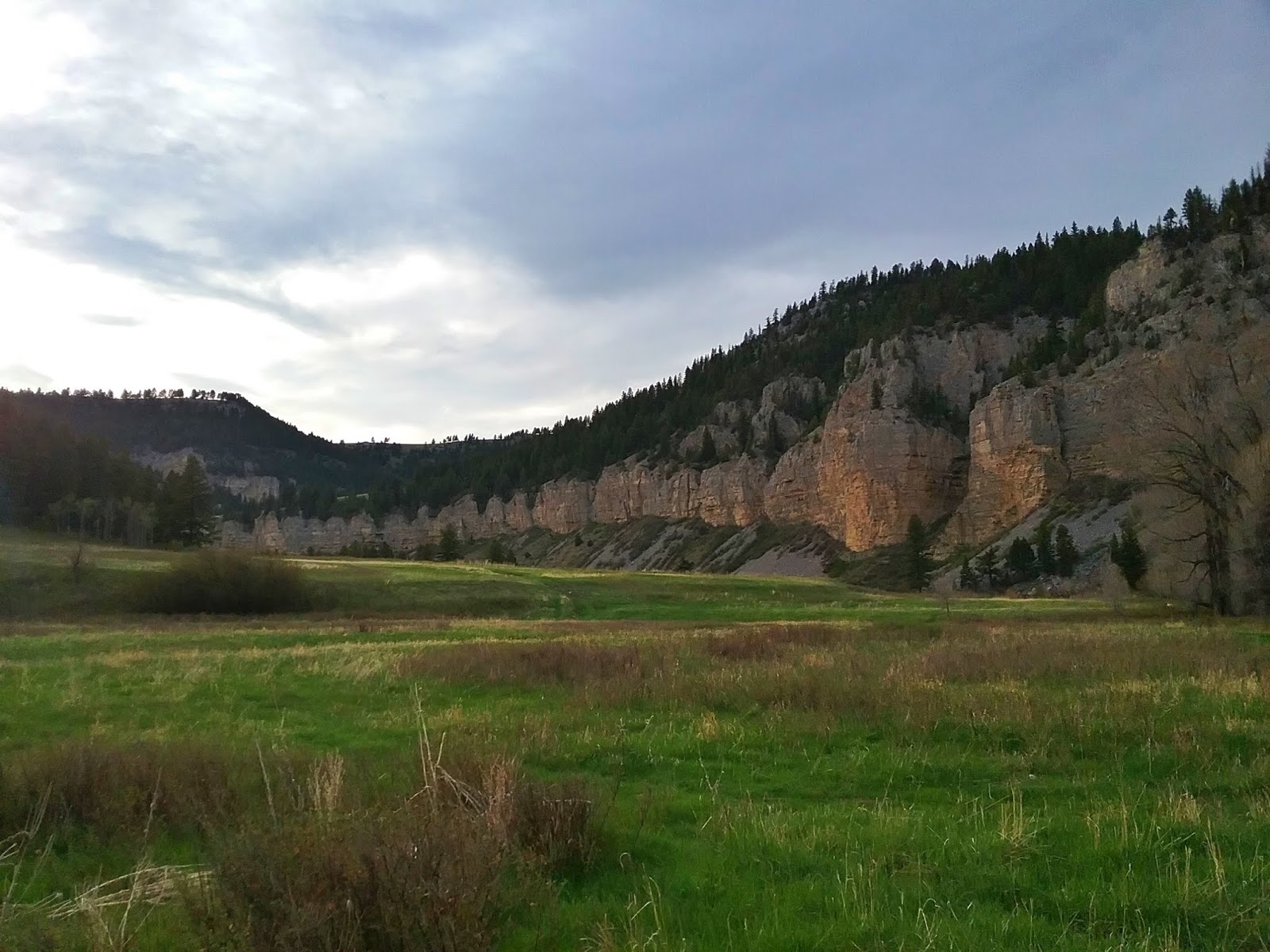
           We donned every piece of dry, waterproof material we had. The rain was falling at a steady rate and there was a stiff breeze blowing upriver. We turned our boats and backs to the wind again and held our heads down as we paddled seventeen river miles to Eden Bridge. The terrain turned from mountainous canyons, much like that of the Gallatin Canyon, to a whole new world. Suddenly I felt like we were in New Zealand. There were flocks of sheep grazing in fence-less, wide open spaces. Giant rolling hills of green were shrouded in a thin layer of mist. The absence of roads, telephone wires, fences, buildings, and people, gave the scenery a boost of  remoteness. Still, the river making sharp turns every few hundred yards. Black Angus cows dot the landscape along with huge cuts of exposed earth and limestone caves. The pines gave way to small trees here and there with geese still all along the banks. The river began to widen up and slow its current. To make up some time I paddled ahead of Cody's boat and imagined a warm, dry Toyota 4Runner patiently waiting for us at the take out. We passed under a privately owned bridge, which read "Eden Bridge take out 5 miles". I was thinking we were much closer than five miles. After the bridge I entered a pretty large farming operation. Someone was sheering sheep in a huge metal barn. As I silently drifted by, sheep would joyfully run from the barn to regroup with the others. I remember thinking how happy those sheep looked. They do live in a pretty spectacular place. It wasn't much longer after this when I caught up with a group ahead of us, three boats. I was cruising along pretty good, my back downriver; every now and then Id glance back to see where I was going. To my relief, Eden Bridge was much closer than the five miles the sign read. The river narrowed here, braided a few times, I didn't want to miss the ramp. As I made my final turn on this magnificent river, a friendly gentlemen kindly grabbed my throw rope and pulled me in hard against the fast current. We exchanged a few words and I began unloading my gear. About ten minutes later, Cody, Carly, and Riley came down and I caught their rope.

          Eden Bridge has some of the nicest changing facilities I've ever seen at a campsite. I guess this is where part of my floater fees comes in, and I'm more than happy to pay them if this is where it goes. There's dumpsters there to get rid of all the trash we accumulated and a camp host who is happy to answer any questions you might have. From here we loaded both rafts onto the trailer and we began the long drive back to Cascade, down to Helena, Townsend, back over to White Sulphur Springs, then north to Camp Baker. Once my raft was in my own vehicle we made the two hour drive back to Bozeman.

Incredible scenery
         This trip is something I will pursue every year. MTF would like to start an annual Smith River float trip. The more folks we have putting in for the permit, the better our chances. If you'd like to join us, feel free to send me an email. I will post information next year about the upcoming float possibilities.  Next time I would like to add one more day to the adventure. Scheduling a layover day would be nice. We had more than enough food. I'm glad I didn't rely on eating fish, I would have been hungry. The fishing was tough. Cody hooked into a couple of trout but there was literally zero clarity in the water. The river is rated as a Red Ribbon stream, which obviously isn't as good as the many Blue Ribbons we have in SW Montana, but still holds some very respectable brown and rainbow trout. Prime time to float the Smith River is May 25th through mid July, after that, the river gets too thin to float in the bigger boats. I would say a beginner could navigate a large raft down the Smith, but you need to respect the river. I also came to the conclusion that I myself would not float a canoe down this river during high water. There are too many heavy currents, pushing water all over the place, up against cliffs, etc. The wildlife was abundant. The myriad of waterfowl was incredible. Baby goslings were with about every other couple of geese, some trying to tag along with our rafts. Birds of prey, bears, deer, elk sign, and plenty of baetis hatches were visible. We were actually rather lucky to see three bears. We talked to a couple other groups, and people that have floated it in the past, and none have had bear sightings. The weather, despite the rain and low thirty temperatures, we managed to stay relatively dry and happy. It can snow every month out there, so its wise to always bring a bag with full winter gear, including the infamous 'goggles'.
View from our hike looking for the cave


Sunday, July 5, 2015

Kayaking For Trout: Ennis Lake


            I didn't know what to expect when Mark said he wanted to take me out on Ennis Lake. The thought of eighty-five degree rays of sunshine pounding me nonstop had me on the fence. There wasn't much of a breeze nor any trees for shade, temps to climb. I can handle the sun and heat but can the trout? Would they be willing to bite on a day I would typically hit the much colder Gallatin River, or even stay inside until things cooled off? On the other hand it was an opportunity to learn new water and take a ride in a top of the line kayak. Of course I had to go, there was no choice! Lately I have been a pretty avid fly fisherman, however, I was told to bring spinning gear along on this trip as well as fly gear. The hunters would be white Zonkers, Marks Muddler in olive or purple, and gold/silver Vibrax spinners. There would be little to no nymphing or dry fly fishing. It was four o'clock and we were fishing into dark.


        The Montana air was calm when we set out from the launch. The lake was still and looked like glass. I was eager to make the mile long paddle in a vessel I had little experience with. I was pleased to be gliding across timid water and not thrashing through two foot white caps. The kayak was stable and a pleasure to pilot so far. The lake was fairly clear, at times only three to four feet deep. Strands of vegetation rise up from a sandy colored bottom. An occasional submarine would dart out from under me, effortlessly gliding into the deep. I was seeing four and five pounders every hundred paddle strokes. "What was this madness?" I said to myself,  "a lake not full of fifteen inchers?" I beat the temptation to stop and throw a trolling line out as I was eager to find some structure. The paddle in only took twenty minutes. I looked back across the vast space we had so effortlessly conquered. I could tell this  particular location was difficult to get to by foot and impossible to reach by car. I put down my oar and slid quietly across the water. I was taking it all in when I heard Mark's rod clunking against the bottom of his pirogue. The lake was behind me as I was looking at the long and desolate shore. There beyond my left were pieces of land sticking out into the lake, each like long fingers almost anatomically perfect to a human hand. Each finger protected from view narrow strips of tributaries that were dumping cold water into the lake.

Snapshot of the days big brown trout
        Mark and I started throwing spinners to the bank and it wasn't long until we both got on the board with above average fish. I gave standing up and fishing out of the kayak a try. The craft was remarkably stable. I could even kneel down perpendicular to the bow and stern. The way our surroundings looked and the sense of standing gave me a similar sense to that of flats fishing down in the tropics. The advantage I had, getting over the glare angle and being able to see farther away, made whole setting highly gratifying. We both slowly worked our way to an inlet and began fishing all the structure we saw. Fish after fish were averaging seventeen to eighteen inches. It was in one of these inlets that I pulled in my biggest brown to date. Granted, she wasn't caught on a fly rod, but that didn't make anything less exciting nor intense. It was a ten foot cast right next to an undercut bank that instantly led to a fight to remember. As soon as I could close the bail and begin to reel, the water boiled. This fish made a mad dash for me, and then right past to whip the kayak around. Again, after feeling the tension of the line, the huge brown hauled me around once more. There was a dark torpedo rapidly strafing back and forth, fighting for its life. She tried relentlessly to get into the undercut bank but I was stronger. It wasn't but a few moments later and she was in the net briefly before quickly tumbling back into the water. I was baffled by the whole scene, only to be left wishing to have spent a few more moments to admire the size and beauty. I quickly shrugged and began maneuvering deeper into the maze of cuts and braids.

        An hour or so of some of the best trout fishing later and Mark and I began paddling our own ways within this delta-like environment. Knee high, lush green grass dominated any land along with a few short trees and bushes. The grass on the banks dropped off to fist size river rock, that, if not undercut, would slowly taper into the shallow channels. A few islands were here and there making for good structure.  I pulled up behind one of these islands to eat a snack and recharge. I'd flip a spinner through an eddie with a sandwich in my hand and pull in a hog. I could ever so often hear a fish break the surface from Mark's rod as he was a hundred yards down. The wind began to pick up making for some choppy water, which I love to fish so I changed to a Belly Bouncer streamer AKA Zonker. I really knuckled down and tweaked my "swing" technique until I was hauling in the big boys. I stood before a section of current as I was knee deep, cast forty-five degrees downstream, and let the current swing my streamer down. As it rolled through the rocks a flash would be emitted from the lure, resulting in a ferocious, self-setting hit. I'm sure Mark could hear me yelling as my adrenaline took over. Again and again the fish leaped out of the water. The fight went on for a good five minutes. The last fish of the day ended up being a nineteen or twenty inch rainbow on my five weight rod. One of the best fights I can remember. The time was only six-thirty.
Average trout 

       As I was getting ready to head up into the unknown, Mark was paddling my way. The wind was blowing rather hard at this point. As an inexperienced kayaker  and lake fisherman I was unsure how this would play into our day. By the time that thought was over Mark yelled "We've got to get out of here man, sorry to cut your day short but the lake is looking pretty bad". I didn't argue when I looked down and saw two foot rollers pushing against our way home. The earlier calm and friendly lake turned into a grey beast churning and spitting. I knew it would be a rough paddle. I stowed my gear, we put our heads down and pushed back through the winding narrow sections we came through. The moment we got out into the main body I knew we made a good choice getting out before dark. The spray from whitecaps taller than the kayaks felt like a constant rain and not rolling over was a goal. The headwind was so bad that stopping to rest would result in the loss of fifteen feet in a few moments.  I wanted to troll a spinner on the way back but catching a fish would lose me twenty minutes of paddle time.The paddle back took us twice as long and three times the effort.

       The day ended at eight-thirty and overall was one of the best days of fishing I've ever had. We had both quality and quantity in a relatively short period. The rough paddle back was only the toll for an epic day and part of the whole adventure. I will surely get back there but unfortunately the only way to reach it is by kayak or canoe. The kayak, for me, was a whole pleasure within itself. The ability to silently glide into position and remain stealthy while fishing is a great advantage when fishing for trout. Rafts, catamarans, and belly boats are great for rivers or small lakes, but the Predator MX takes it when it comes to paddling long distances with ease. A big thanks to Old Town Canoe, Dave Howlett, and Mark Lyon for making this experience happen. The video of this adventure is below. Tight lines everyone and thanks for reading! -Mike


Wednesday, November 5, 2014

My Quick Tips: Fall Trout Fishing


Fall is a beautiful time to be in the river. (East Gallatin)
         Fall has certainly made an appearance in my part of the country. This time of year is known to be one of the best seasons for fly fishermen. The waters are low and clear. The summer tourists are long gone. The big browns swim out from cover looking to feast upon an abundance of food, food that will help them survive the winter. Colder temperatures shut down the highly productive insect cycles and slow the trout's metabolism. They need to stock up in order to survive the harsh months ahead. Think of a bear in pursuit of food before hibernating; when bears are often causing the most trouble. It's then that they lose their ability to rationalize and think adequatly, pushing their limits to find sustenance. Large browns will go out of their boundaries too. They realize that they need to act when the opportunity arises instead of waiting until conditions are just right. Big fish are less likely to be pushed into cover for the majority of the day, only coming out to feed at night, when they are desperately trying to get fit for winter. After the leaves have changed and before the snow constantly falls, big fish swim hungry under the ever lowering sun. Its fall when the twice-a-year angler can dawn his waders and head to the river with significantly greater chances of hooking into a trophy fish.

        I realize that to catch more fish you must increase your odds of doing so as much as possible. That sounds simple enough, and it really is, but that must always be on the top of your mind if you want to be successful. Taking that, we can break down the best times of the year and focus on the type of fishing for each. My two favorite times of the year are after the spring run-off and during fall. I have focused a lot of my attention on learning how to fish post run-off. I have learned the about the insects that hatch that time of year, where the fish are holding, how rising water levels will effect them, etc. I literally imagined myself as a fish trying to survive, thinking like a fish in every aspect, I almost felt loony. We can do the same for fall fishing. We know it is one of the best times of the year to wet a line, so why not learn all we can to fish it even better?

Fall trout feeding on BWO's
      I really could write for pages on this subject, but will try and share some big points. The trout, especially the large ones, need energy to survive the upcoming harshness of winter. A lot of animals die every year in this part of the country, including trout, because food becomes sparse. The caddis and mayfly cycles almost come to a halt in the middle of winter. Terrestrials are rarely seen on the banks, let alone in front of a hungry trout. Even the sculpins and crayfish slow down and burrow into the mud and rocks. The whole underwater scene that is so prolific with life during warmer months turns into a gloomy, dark, cold deathtrap for any living creature ill-prepared. That being said, the fish are hungry in the fall! The high sun and clear skies which make trout weary are turning into shorter days and overcast skies. Big browns have free range in any water they desire. Try fishing those places that held no fish in the summer. The shallow riffles that were too warm in the summer are now as cold as any other part of the river. Remember this and apply it to your waters. Knowing the above will boost your morale and help you catch big fish. Fall is also great time to fish streamers shallow with floating line, whereas during the summer, you would need a sink tip line to fish deep during the hot days.

       Large streamers are known to take hungry browns during fall, but don't forget about the tiny midges. My fall setup is often a large lead fly, say a salmonfly nymph, above a tiny #20 blood midge, or zebra midge. Midges are one of the few foods that trout prey upon year round. You can bet that midge hatches happen almost everyday during the deep winter months. The idea of big fish on tiny flies is intrigueing yet can be extremely frustrating. My largest trout was a Madison River hog, hooked in the lip with a #22 lightning bug. He held on for five minutes but the hook quickly came flying out of his mouth when he left the water that one last time. Despite that, fishing small flies into fall is a must to catch large numbers. Another excellent fall pattern are small pheasant tails. This time of year, the Blue Winged Olive is a common site in western waters. Pale Morning Duns and Pale Evening duns also commonly rise from the rivers during fall. PMDs and BWOs are the two dry flies you will want to have in your box, along with all of the stages of these bugs lives. You will want to imitate the size more so than you did during summer. Some of these fish have been thrown every fly since run-off and havent yet had a winter to get adjusted to less pressured life in the stream. The water during fall tends to be low and very clear. Concentrated fish are a good thing, but they are weary, and will become less weary as the need for food becomes more important.

         So there you have it. Since there is so much more I could discuss, I give you now the basics to fall trout fishing. Maybe I will make a part two for fall 2015. I hope the novice fly fisherman can learn something from this or perhaps the intermediate angler can reinforce their thoughts on the subject. If you're an expert reading this, please feel free to email me and share your thoughts on fall fishing. The sport of fly fishing is a lot like golf, a whole lifetime is not enough to learn every single aspect. I share the same desire as many of you do in pursuing fish and I hope to help anyone having trouble figuring out the riddles of fly fishing for trout. Tight lines all! -Mike

Monday, January 13, 2014

Winter Bliss: A Perfect Day With Mykiss, Salmo Trutta and Williamsoni


             On a perfect spring, summer, or fall day, one would usually not hesitate to jump in the car and head towards crystal clear waters full of hungry fish. I cannot imagine sporting a t-shirt or light fleece and trudging through refreshingly cool water in the pursuit of my obsession. To sit down next to a near perfect fishing hole with the pleasant feeling of the sun hitting my back and neck sounded heavenly. It's the sinuous, warm breeze often providing a harmonious rhythm along side the undulating tone of water. The creatures that hide themselves while I make haste begin to reveal themselves as I sit motionless near the bank. Mule deer, whitetails, moose, and otters are a few critters that I share these waters with. Even birds and waterfowl, as meager as they seem, will cause me to stop what I'm doing and stare with appreciation. It's days like these that "fishing" may not be why I am out here at all. I might as well leave the pole in the car, but catching a fish would be a nice bonus on such a perfect day.

         This winter feels especially cold, much colder than last year. Cabin fever has set in. I know that fishing follows the same aspects during the winter as my activity outdoors declines. The fish slow down and the fishing isn't worth writing home about if the temperature is below thirty-two degrees. At the first glimpse of a thirty-eight to forty degree day, you can bet that I will be heading towards my escape.

          This particular mid-winter outing was a blessing for not only my sanity but for my overall quality of life. To some, fishing is as I explained previously, a good reason to enjoy the outdoors. But for others, fishing satisfies the soul. Setting out to accomplish the task of reeling in a beautiful specimen from a beautiful, untainted body of water is something we've tried to express in articles for decades. No longer are we fishing for the survival of our families but for sport. A half day jaunt into their world only to succeed in what we set out to do is a very good feeling. Walking in and out of mother nature's world only to catch, photograph, and release trout; leaving no sign or trace except for the digital files I take is a win in my book. On this mild day in January, I found all of this remains true to me and a very blissful experience followed.

         The middle of winter submitted to a wonderful fifty degree day. I was lucky enough to be off of work on this day and I knew just what I was going to do. I arrived at the river around noon. It was nice to leave the jeep without gloves, a mask, or a hat. I didnt care how the fishing was, the day was too perfect to be indoors. I remember having the feeling that I was the only person fishing or perhaps the first person to fish this river since fall of last year. The woods and stream had a remarkable vibe that day. The instant that I stepped into this world something engulfed me, I started to get that feeling deep inside. This wasn't the picture perfect day like I had been dreaming about but it was its own unique blend of pristine serenity and beauty. I had miles of shimmering river that was mine to fish alone, which I generally enjoy. Not to say I dont enjoy fishing with friends, but fishing alone is what I enjoy most. While I made my way to my honey hole, which is about a mile walk around tight bends and through several crossings, I had spooked several mule deer which in return spooked me. Eagles gazed down at me as I passed under their perches. I thought I could toss them a trout and make some friends out here. On this day I was happy to be outside and with all I've seen I could have left happy. Then I started thinking about why I was here. I had the urge to catch fish.

       As simple as the phrase "catch fish" sounds, its really quiet deep. This was no task of simply putting on a lure and casting for fish. I was in predator mode, trout slayer mode. It was such a perfect day, however I had yet to please my urges. If I had brought a partner with me it would've been hard to hide my excitement. Like a bass angler sizing up his competition during a tournament, I too was sizing up my opponent; the river. Many say when it comes to trout fishing, that slower is better. Its taken me two years to focus on this idea. Fishing slow for trout can mean fifty different things. Today, me being slow means walking and moving slow while near water that holds fish. I also vowed to myself to fish each hole with more patience, allowing nearly four times the length of time I would usually fish one spot. My bad habits include making ten casts and moving on to the next hole or run. My theory today was conjured with the idea of catching the most fish possible (have to catch as many as I can). The ideology behind the fishing slow is good for a few reasons; mostly because the trout were still cold and a bit lethargic. Fishing slow gives the trout more time to see and consume my flies. It paid off very well.

          I fished my honey hole harder than I would have during warmer seasons. This spot was like a control in an experiment. If I couldn't take my time and catch fish here, I wasn't going to have much luck anywhere on this river. Normally I will fish with general flies that I know work; san juan worm, girdle bug, leech, eggy, blue midge etc. but this day I managed to retie a few times until I found something that worked. I managed to slow down, be patient, cast, cast, retie, cast, retie, repeat, repeat repeat and it paid off! I landed six trout once I  had figured out what they were eating. The fly of choice by hungry trout happened to be a number twenty-two olive midge nymph. They were going nuts for it! I finally dialed into exactly what they were feeding on.

        During my walk back to the jeep, a small riffle of water quietly flows into a 15x10x3ft pool and catches my eye. A stealthy approach gets me within viewing distance and I see nothing but cold dark water seemingly void of all life through my polarized glasses. Should I keep moving or gamble wasting time on such a small pool? Maybe they were holding tight against the sides. I plan my assault, observing everything about this deep little pocket of water such as how I imagine the bottom to be, possible depth, current, obstructions, fish flashes. First cast into what seemed like a hopeless, lifeless body of water and I get snagged. The snag suddenly turned into the shape of a golden silver torpedo as he started to fight, reflecting light off his sleek body. I was just stoked! I was amazed at how many trout and whitefish were in this small pool or water. Life was literally thriving everywhere. From there on, every hole I stopped at held many, many fish. They were stacked up in these holes which I had fished so hard on my way to the honey hole. The right fly was the game changer it seemed. I took my time and landed a dozen fish and hooked twice as many on my way back.

       While my trail merged with another, I spoke with a fly fisherman who was just getting back from fishing upstream. We exchanged info. In that I learned he hadn't had the great day that I did. The empty hole in my soul was now stuffed with satisfaction of a day well fished. We walked back to our cars together talking about what a great day we had. I showed him what I had used to catch my trout and he was happy to be informed. We had a lot in common I realized in just those few minutes we chatted. We were the few who yearn for such days, and the only ones taking advantage of this particular day. I knew that despite this older gentlemen being skunked, he had just as great of a day as I did. I took a moment to reflect these thoughts. More often than not we're out there alone. It's either a guide with a client or a couple when I see pairs. I love this place because of fly fishing, if not for fly fishing I wouldn't fully experience it. I feel fortunate to have discovered the world of fly fishing and trout in big sky country. Fly fishing has mended with my spirit just like the connection of a mighty trout through a fly rod.          Tight lines all!


Thursday, June 13, 2013

The East Gallatin Proves Again! 6/12/13

       The East Gallatin has once again proven to me that it remains a top-notch fishery within the city limits of Bozeman. Having such a place so great, and under-fished, ten minutes away, I often forget its even there. With the big rivers also within a reasonable driving distance, many people don't pay much attention to the East. The day was June 12, 2013. Thunderstorms were threatening my day in the water and time was against me. The temp was seventy-five degrees and the barometric pressure was falling. Water level was a bit high but visibility remained well enough for an excellent day of fishing.
     
         I started off at the Cherry River fishing access right off of Frontage Road. I had rigged a nymph-style, red san juan with a pheasant tail flashback on the bottom. The first hole I fished was at the end of the meandering foot trail that branches off from the main walking path. There is a nice little informative display about the fish that are found in the East Gallatin. It often poses as a good place for visitors to watch a fisherman catch a trout. Today I was on display, performing a handful of catch and releases for an audience of three people. It was enjoyable for me and them alike and I eventually had to move on. Around the next bend there are a couple of good runs but nothing produced fish. I crossed the river which was knee high and reasonably easy to pass. I made hast to find another similar hole such as the previous before the weather turned.

         By now, Im fairly secluded from yards and trails. Way back deep in the oasis that is the East Gallatin, I was hearing trout left and right. Big fish slurring in the shallows under trees. Little trout were flinging themselves out of the water about every eight to ten seconds. I was getting a feeling that these fish haven't been disturbed since last fall. The incoming weather was also for my advantage. I managed a few more twelve inch rainbows and a few more snags, resulting in using up my leader. I figured since I had a short leader, why not tie on a streamer? I chose a fairly heavy, large black streamer. I'm pretty good at pitching them right into the strike-zone, sometimes its within the same area as a basketball hoop. The risk at hand is losing a good fly and the time lost re-tying. The rain had started lightly falling and the wind had picked up. I was inside of this miniature wilderness which was coming alive as the thunderous anvil remained ominously in the background. Deer were on the move, birds and waterfowl were flying with a mission it seemed. The trout were hitting bugs off the water left and right still, and I now had a streamer in hand.

          I was quickly targeting the banks of either side, where there was slower moving or still water. Often with a backdrop of rip rap or gnarled up driftwood, bushes, and sometimes a car, I cast within an inch of the bank. The sound of the heavy streamer hitting the water will turn the head of any predatory trout. Brown trout are the beast within these slow pools of water. I noticed a small piece of water that was much slower, the current blocked by underwater debris. I knew there should be a fish lying there. The first cast hit the water with a hefty splash and I could see a bronze flash, a turn of the head and my streamer inhaled. I set the hook hard knowing what I had. The water then exploded and the fight was on. I was using a four foot leader with some 3X tippet tied on. I wasn't all that concerned about the tippet breaking until he ran into some deep, fast flowing water. It took me about three minutes to get him in calmer water. He then got tangled up in some sticks and I had twenty feet between me and him. I ended up getting him freed and to the shore. I snapped a few pictures, revived, and released him. I didn't get a length, but to me that was not important. It was a heck of a fish for such a small river and a very beautiful one at that. I managed two more nice browns on my way back and missed another nice one, perhaps the biggest of the day.

            Overall, it was an absolutely epic day in my book. I'm still avidly learning this sport and its great when you can catch a lot of fish. This greatly speeds up the learning process when you have so many opportunities to hook a trout. Its better yet having wild trout at the end of a line. That adds another layer on the cake. I managed a dozen or so rainbows and small browns with my nymphing set-up and three very nice fish on the streamer. I enjoy fishing both styles, but the process and reward of effectively using a streamer is incredible. Sure the East G. is a smaller river and has plenty of small fish, but it holds some very big trout, perhaps more so than the Gallatin River. I will always appreciate the East Gallatin River, it proves to be a quality river with little pressure right at home. Maybe I will see you out there in the water!

Sunday, April 28, 2013

The East Gallatin River

               The East Gallatin starts off north of Bozeman as a small stream. As it makes its way west the river picks up a few spring creek tributaries and other run off creeks. By the time the East Gallatin meets up with its big sister, the West Gallatin, it's almost the same size. Most of the river meanders through private land so wading is needed to fish it well. The East Gallatin is considered navigable and the deeper, wider, western parts are float-able with tubes. This particular river is often overlooked by the majority of fly fisherman. Most are out enjoying the bigger well-known rivers that are nearby. The East Gallatin offers plenty of trout that, unlike the bigger rivers, are much more willing to take whatever is offered to them. The river is also very close to home. What a great place to go if you don't want to drive more than fifteen minutes to wet a line.

Upper section near Cherry River access
               With access right in Bozeman, the upper section is a quick escape to trout land. One could walk around a  few bends and suddenly be lost within thick deer and bird habitat. The sounds of the outside world are swallowed up by the rushing water and bird chatter. The rivers upper section is all around smaller, with rapids, runs, and pools. There are plenty of trout that live in this ten to fifteen  foot wide river section. I've had good luck here during fall, winter, and spring. I like to fish the upper section of the river when its windy or the weather is bad. The trees in this area of the East provide plenty of cover from the elements. With tight spaces, trees and thick brush, a smaller 7 foot rod would be practical.

Middle section
              Downriver from the Bozeman accesses (Cherry River off of Frontage Road and East Gallatin Recreation Area off of Griffith and Manley) there are a few other accesses. This is the middle of the East Gallatin and it spans from northwest of Bozeman to Belgrade. I use Google Earth to find all of the bridges and then see what kind of parking it provides. Bridges are legal access in all of Montana's navigable rivers. From then on you've got what seems like endless miles of trout water all to yourself. The trees that surrounded the East Gallatin a few miles upstream are now replaced by bits of trees here and there along with a few houses. Lots of rip rap used to secure the river from moving through peoples yards is scattered around bends. When flows are normal one could easily walk the banks without having to be in the water. 

Lower-mid section
              The further downriver you go, I believe the bigger the fish you will find. The river downstream from the middle section widens and deepens causing the flow to slow down. Big brown trout thrive in this kind of habitat where minnows, insects and other aquatic animals live. Streamer fishing targeted at the undercut banks will provide, from what I hear, some very nice brown trout. I tend to focus on this downstream section more this year. I believe it gets a lot less pressure and certainly a lot less live bait pressure. Waders are a must and a tube would be ideal for the western portion. The deep water and high banks make for constant wading. This section of the river is the most secluded section and offers one the ability to escape into Montana's great trout wilderness. Both sides of the bank from here on down are occupied by vast fields of wheat and grass. Its easy to get lost in such a slow moving, beautiful place. 

               The East Gallatin offers many opportunities to catch trout, hone in on skills, and enjoy the peace and quiet of the outdoors. The amount of nature one absorbs while standing in the East Gallatin, listening to the wind and the trees, the flowing water, birds, and among other things, catching trout, is what were really out here for. Too many people now a days are stuck in urban jungles or places without wildernesses and don't get out enough to really enjoy the outdoors. The East Gallatin provides this in an overlooked place right next to home. 
\

Thursday, April 25, 2013

Quick Tip: Trout Photography

        It was probably the second or third outing to Hyalite Creek that I realized how well the beautiful colors and markings of trout could be captured. It was a small brook trout I had taken a picture of with macro settings that inspired me from then on to photograph nearly every fish I've caught. All of my photos have been taken with an eight megapixel camera phone. Its quick and easy to take out, snap a photo, and continue with what I was doing.
     
        I was experimenting a little bit when I snapped my favorite picture yet. I was too far in the middle of a fairly quickly flowing river to get a good picture without the risk of losing my phone. I held the fish by the line so the water was gliding beneath it, sort of splashing and turning slightly back and forth. I took as many pictures as I could and quickly released the fish.

         An hour or so later, I looked at my photos and first noticed the nice colors on the fish, but there wasn't much I could do with a fish that looked so awkwardly hanging by a line. I turned the picture ninety degrees to the left and it looked just like the fish swimming through the water. A quick cropping to cut out the fly line, and a lomo filter was all that I used to bring out the real color of the scene. A swimming fish was created out of a somewhat dull photo.

          I've found many neat photos can come from photographing trout. People have been doing it forever because its not hard to take a bad picture of a trout. Trouts ever so changing beautiful colors, the suns vibrant light rays, crystal clear water, and bright green vegetation make for excellent captured moments. Macro settings are a must if taking a picture closer than ten inches. Next time your'e fishing, bring a decent camera, don't get it wet, and take some great pictures to share with your friends. They're some of the fish that YOU'VE caught and now you will never forget them.

Taking many pictures gives you more to work with in this case and increases the chances of capturing a good shot.